Why Tango Musicality?
Like most dancers who begin learning tango, during my first years I focused primarily on figures and movements. As classes progressed, I learned new combinations and naturally concentrated on improving my technique. Like anyone who spends enough time on the dance floor, I eventually realized that in tango the true leader is not the dancer—it is the music.
After some observation, I began noticing significant differences between dancers performing the very same movements. Some couples were not particularly technical, yet they seemed completely connected to the music. They reacted to subtle musical changes and responded to the energy of the orchestra. The music almost became visible through them. That was when my awareness of the importance of tango musicality began to develop (I'm talking about the early 2000s).
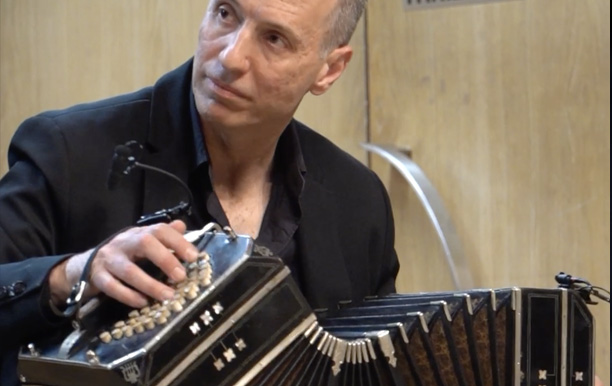
In 2004, shortly after I started learning the bandoneon, I attended a three-day workshop taught by Joaquín Amenábar, who, as far as I know, was the first tango musicality instructor to teach in Turkey. That experience completely changed my perspective. From that point on, music became my primary focus.
Over the following years, studying tango arrangements and performing tango music gave me a much deeper understanding of both sides of the equation. In 2007, I organized my first Tango Musicality workshop at Shine Dance Studio in Ankara, and since then I have taught this subject at various dance schools. Since 2024, I have also been teaching a semester-long, credit-bearing university course called Tango Musicality to dance students at the Middle East Technical University.
But enough about me—let's focus on the subject itself.
When we think about the roles of leader and follower in tango, it can be said that the leader is first and foremost a musical interpreter. The leader does not simply guide their partner; they transform musical information into movement. The follower experiences that interpretation through their body and responds through their own movement.
For this reason, the leader's task is not only to know which figure to perform next, but also to understand what they are hearing in the music at that particular moment and to translate that understanding into the dance they share with their partner.
The challenge is that tango music is far more complex than it may initially appear.
Argentine tango orchestras often feature strong rhythmic structures, syncopations, marcato patterns, and sudden changes in tempo and intensity.
Many dancers begin by following only the basic beat. However, once they start listening more carefully, they realize that an orchestra is actually producing multiple musical layers simultaneously. In particular, para bailar tango music—music specifically designed for dancing—contains very clear signals intended for dancers. A dancer familiar with tango musicality can recognize these signals and incorporate them into their dance.
For example, while the double bass and piano may be maintaining the fundamental pulse, the bandoneons may be creating syncopated accents on top of that rhythm, producing a polyrhythmic texture. Or the violins may be carrying the melody while the piano provides an alternative rhythmic structure for the dancer to follow.
The dancer's task is therefore not simply to keep time. It is to hear these different layers—the signals being sent by the musicians—and decide, moment by moment, which of them to respond to.
An important part of tango musicality is also related to listening skills.
Many dancers believe they are listening to the music when in reality they are only following the rhythm. During musicality training, however, different questions become important:
- Which instruments are carrying the melody?
- How is the energy of the orchestra changing over time?
- How can shifting rhythmic structures be recognized and translated into movement?
- Which movements are most appropriate for the musical phrase currently being played?
- How can a dancer anticipate the flow and direction of the music and prepare in advance?
For these reasons, the goal of Tango Musicality classes is not to teach figures but to teach people how to listen.
Students learn about the fundamental building blocks of tango music, including rhythm, syncopation, melody, tempo, musical forms, phrases, pauses, and changes in energy. They also learn how different orchestras employ these elements in their own distinctive ways.
As I have often emphasized, this process is usually more difficult than people expect.
Musicality is not a skill that can be learned in a few weeks. Just as a musician gradually trains their ear, a dancer must develop their listening ability over time. Learning to recognize an orchestra, distinguish recurring rhythmic patterns, anticipate musical changes and signals, and express them through movement requires years of accumulated experience.
The reward, however, is immense.
At a certain point, dancers stop dancing merely to music and begin dancing with the music itself.
Figures move into the background. Movement becomes a natural extension of the music, and tango transforms from a sequence of steps into a genuine musical experience.
As musicality develops, dancers begin to experience the same orchestra differently each time they hear it. A violin phrase in a recording by Carlos Di Sarli that has been heard hundreds of times suddenly becomes noticeable. A bandoneon melody in a piece by Aníbal Troilo emerges for the first time. The moments of tension and release within an arrangement by Osvaldo Pugliese become more apparent.
As a result, tango ceases to be an activity built around repeating figures and becomes a living experience that is rediscovered anew in every tanda.
Back to Blog